
Arto's Blog
How I became a child of the Rainbow Family
Posted: 2008-09-03 13:37:35, Categories: Travel, Ecology, Serbia, 1300 words (permalink)
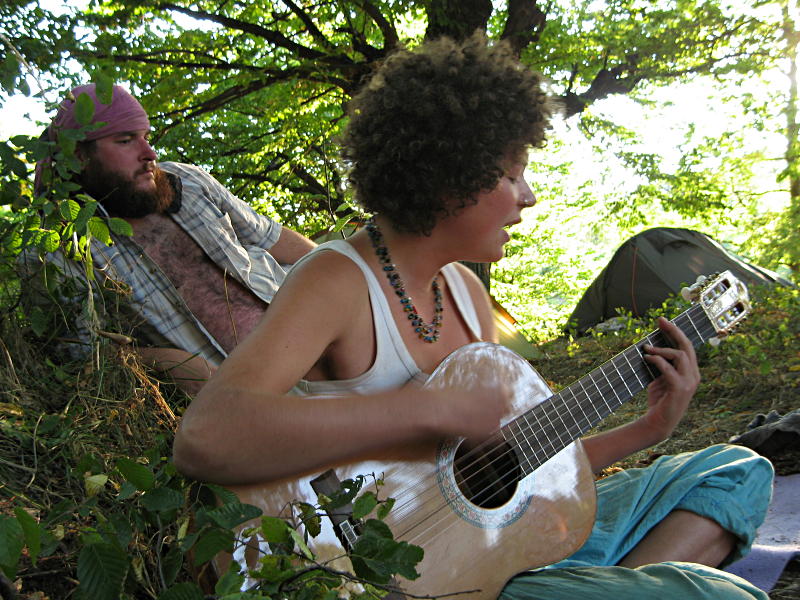 The Rainbow Family of Living Light meets in different locations around the world, creating spaces for alternative living in natural surroundings, disconnected from the rest of society. This year the main European gathering was in Eastern Serbia, from 2nd until 30th of August. I spent two weeks there and will tell you about Wednesday August 13th, my third day at the gathering. It was just a day among others, but for me it was an important one.
I got up around 9, or perhaps it was 10, time didn't matter. The sun was already high but it was nice and cool under the trees where my tent was. I spent a good half an hour doing some stretching exercises to wake up properly and feel good.
I walked up the hill to the common kitchen, where brothers and sisters were preparing breakfast. Lunch might be a more correct word, as the first meal of the day was usually served after midday. Working in the kitchen was a good way to make sure that the meal would actually happen and a get a little bit of breakfast while doing it. I helped to cut watermelons and started digging a new compost because the old one was full.
That was enough work for the day. The compost was not finished but someone else would continue digging later. Just before eating I took a shower to wash off the sweat. Yes, there actually was a shower, at the end of a garden hose coming from a spring further up the hill. There was no shower curtain but being naked was considered perfectly normal at the camp, and there was no fear of paparazzis showing up to take photos.
About 400 people formed a big circle around the main fireplace, sang about the unity of the family and then ate together. Food was muesli and fruit salad. Towards the end of the meal people went around in the circle announcing the day's workshops or whatever else they wanted to say. Last, a small troupe playing cheerful music made a tour with the magic hat. Money put in the hat was used to buy ingredients for the common meals.
After eating I had a bit of rest in the shade at the Polish camp, called so because mostly Polish people happened to be camping under those trees. Ola had been learning shiatsu in one of the workshops and wanted someone to practise with. I volunteered and got a relaxing massage.
I didn't do much else during the afternoon except going for a short walk meeting new people. Evening came and there was a second meal with the usual rituals. Sun was already down but there was light from the almost full moon, stars and a number of campfires.
One of the announcements in the evening food circle was for angel walk. Participants stood shoulder by shoulder in two lines facing each other, leaving a narrow corridor in the middle. One person at a time walked slowly through the corridor, eyes closed, receiving hugs, gentle touches, kind words and other gifts of love from others. At the end, all came together for the big final collective hug. It was a wonderful experience, both drawing and giving a lot of energy.
Around the main fire, three drummers were pounding tribal rythms, together with one musician playing a large wooden xylophon. I danced wildly for a short while before walking back to the tent, exhausted but happy. It was clear sky so I pulled my sleeping bag out from the tent to sleep under the stars. That moment I felt Rainbow was a family I wanted to belong to.
When I talked to people who had been to Rainbow gatherings and searched for information online, the opinions varied wildly. The invitation would describe a paradise where everybody lived happily in perfect harmony with the nature loving each other, while critics would describe Rainbow events as bunches of pot headed survivors hanging around. The reality, not suprisingly, was somewhere in the middle, and depended greatly how one personally chose to live it.
I particularly liked the idea of no trade of any kind inside the camp. The only thing involving money was the magic hat, with both rich and poor being equally welcome. As time passed, the rule became gradually less strictly followed with local farmers coming closer and closer to sell their products and camp participants flocking to them to buy cheese, milk and other goodies not provided by the common kitchen. Still, it was certainly possible to live without using or thinking about money if one wanted to.
Compared to Ecotopia, which I attended two years ago, Rainbow was less political and more spiritual. The setting was almost the same: camping in the nature with basic facilities, common vegan or vegetarian meals, decisionmaking in a circle and music around campfires in the evenings. However, while Ecotopia was full of workshops about learning ecological ways to live, co-operating with the nearby eco-village and thinking how to change the world around, Rainbow was more about creating an alternative world, being there and feeling it. Be the change you wish to see in the world, as Gandhi once said. There were workshops in Rainbow as well, but in a more relaxed schedule and focusing more on arts or finding oneself through meditations and spiritual exercises. Some interesting discussions about politics and about Rainbow itself happened under a big tree in the library, which also offered a selection of books to read.
The Rainbow gatherings got started in early 1970's in the U.S. from the late 60's hippie movement. Still the biggest gathering is in the States each July with over ten thousand participants. First European gatherings were in the eighties and now there are both local small meetings as well as big international gatherings on all continents. Curiously, the trend seems to be towards more small local gatherings while the number of people attending the big ones is in decline. The European gathering in Serbia drew about one thousand people, with the peak being around 700 during the full moon celebration.
Some people live continuously in the Rainbow way, either traveling from gathering to gathering or pursuing a similar lifestyle in one of the more or less permanent Rainbow villages. Most participants, however, have their regular lives in the Babylon, as the outside world is called in Rainbow slang, and the gathering is a temporary state for them. It can be about appreciation of the nature, survival without modern commodities, escaping hectic city live, partying, meeting old friends, discussing life and politics with new people, giving and receiving love, finding a personal connection with the divine, something else or all of the above. Rainbow gathering is a form of tribal living but members of the tribe are individuals, so the experience is at the same time a collective one and yet different for everyone. Some people who had been to many gatherings said that they come each time to feel the spirit of the Rainbow and try to carry some of it with them through the rest of the year.
For me, camping out in the woods was not new by itself, but Rainbow was a learning experience about how people do it as a community with as little organization as possible. The whole gathering wasn't just joy and happiness, I went through a short period of diarrhea and had my days of low mood during the middle of my stay. Overall, I still greatly enjoyed it. I'm too deeply rooted in the Internet age to seek for a life in a Rainbow village, abandoning all modern technology. However, it's very healthy to do it sometimes, questioning the values of the society around us. Rainbow gatherings are a perfect place to do it.
Slow life in Bosnian villages
Posted: 2008-08-07 21:21:50, Categories: Travel, Ecology, Bosnia, Hitchhiking, 808 words (permalink)
 During one week I got an introduction to life in Bosnian countryside by visiting a couple of villages and the ecological community Zelenkovac. Work on the fields was more modernized than for example in Romania, but far from large high tech farms in Western Europe. People had time, nearly everybody smoked cigarettes constantly and guests were received by offering them shots of homemade rakia, a strong alcohol usually made of plums.
In Zagreb, Croatia, I took a train to Karlovac and started hitchhiking from there towards the Bosnian border. A man who built swimming pools for a living took me to the crossroads near Plitvice and a truck driver picked me up from there. It was my first ride ever in a large truck — cool to see the road from high up in the cabin. At the customs the truck had to stop and wait in line. I hopped off, crossed the border by foot and decided to walk to the first village, Izacic, and see what happens.
Hasan was sitting on the terrace of his house and waved me to have a seat beside him and take break. Soon his English speaking son Adis arrived and it didn't take long until I had met some of his friends and been invited to stay overnight. In fact I ended up staying two nights.
Life was slow, especially for the young people who were on holidays from school or university. They killed time sitting outside, smoking, sipping some coffee or beer, chatting and playing with their mobile phones. Inside they had TVs and Playstations but Internet was not common yet. Actually there was an Internet cafe in the village but the connection was broken. Nearest town was Bihac, where we had a picnic by the Una river. Quite a few people had friends or family members who were working in Austria or Germany. They came back in their home villages in the summer to hang around and show off their cars.
From Izacic I moved on to Zelenkovac in central Bosnia. It's a community founded 25 years ago by a painter called Borislav Jankovic, more commonly known as Boro. He moved out of the nearby village to near some old water mills, built a house and started inviting people to visit while working on his paintings at the same time.
Zelenkovac was a lovely place. A small river flowed in several parallel streams through a forest with wooden buildings scattered around. The water mills had stopped long ago but the funky and twisted main building was full of life, with both tourists and villagers coming and going, Boro and his son Alex welcoming the visitors and a few other regulars taking care of the bar. I stayed with some other guests on the second floor of the main building, which had a bunch of old beds and mattresses tucked in different corners of the oddly shaped open space. There was one more room still above the second floor, accessible by stairs outside in the open air like in a treehouse.
Zelenkovac advertised itself as an eco-village, although many typical features of ecologial communities, such as recycling, vegetarianism or environmental campaigning were missing. I saw it mainly as a place to be surrounded by beautiful nature, meet people and enjoy life. The eco aspect was to keep the area at least relatively untouched, live modestly and maintain an open-minded and friendly atmosphere, instead of destroying the site or turning it into a luxury holiday resort. However, Boro had wishes for enlargement and increased visibility. He was planning to organize international volunteer camps in Zelenkovac during summer 2009, which will hopefully succeed in developing the place further in a sustainable way.
In Zelenkovac I met also David and Gareth, two Englishmen who had arrived a couple of days earlier in a 1966 Volkswagen Beetle, or VW Buba in Bosnian. Together with them and Alex we went to the nearby village to help Boro's brother to collect hay. The brother had hurt his hand falling off his tractor so he was happy to get some help. Rakia had probably something to do with the accident — we had already learned that rakia was the fuel for people just as diesel was for the tractor. We managed to collect one and a half small fields worth before a thunderstorm came and made all the rest wet again. Boro's brother didn't seem to worry too much, we just went inside his house for coffee and more rakia.
Zelenkovac was a place I could have stayed in for weeks. However, Gareth was leaving towards the east and I decided to join him. David fetched two French friends from a town 40 km away. Then we packed the bags of all five of us and ourselves in the Buba and drove off towards Sarajevo.
(Slightly edited on 2008-08-09.)
Bicycle 40000 km celebration
Posted: 2008-06-26 13:40:50, Categories: Travel, Finland, Ecology, Cycling, 542 words (permalink)
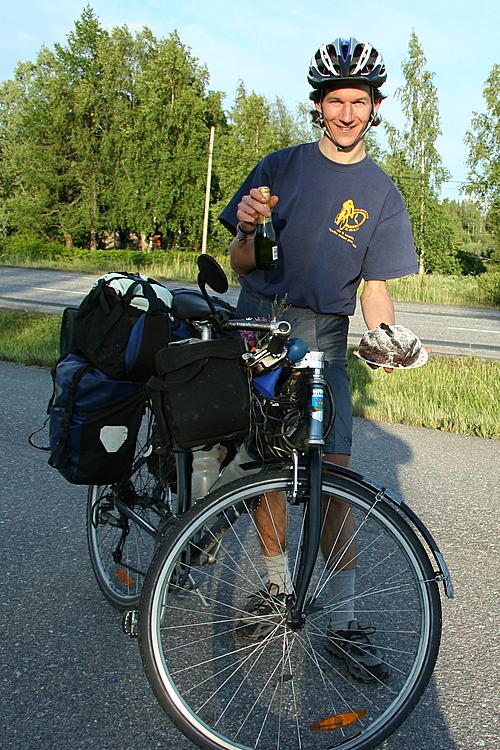 On Wednesday 18th of June, on the way to Åland islands together
with my Lithuanian friend Dalia, my bicycle reached 40000 km. Such a
happy moment was certainly a good reason for celebration, so we
offered it flowers, a cake which looked like a cycling helmet, and a
small bottle of sparkling wine. Well, the bicycle actually prefers
chain oil, so we helped it by eating the cake and drinking the wine
ourselves. It was a small bottle, so we weren't too drunk to ride
forwards after the party. :)
On Wednesday 18th of June, on the way to Åland islands together
with my Lithuanian friend Dalia, my bicycle reached 40000 km. Such a
happy moment was certainly a good reason for celebration, so we
offered it flowers, a cake which looked like a cycling helmet, and a
small bottle of sparkling wine. Well, the bicycle actually prefers
chain oil, so we helped it by eating the cake and drinking the wine
ourselves. It was a small bottle, so we weren't too drunk to ride
forwards after the party. :)
I had switched the cyclocomputer to show the total distance already twenty kilometers before the event. When it reached the magic figure, I squeaked the horn, we stopped and had a photo shoot and party on the spot. Very appropriately we happened to be on the King's Road, and there was a bicycle way next to the main road. People in the neighboring house were surely a bit curious what on earth we were doing, but they were too shy to come and ask.
The bike has now been in 22 countries and although it still hasn't traveled around the world, 40000 km is the equivalent distance. I bought the bike in May 2001 and have been riding it since then except for one year while being an exchange student in Japan 2002-2003 (I had another bicycle there). That makes an average of about 6500 km per year. Roughly half of it has been tours and shorter recreational outings, the other half being commuting and other everyday use. Everyday use includes also plenty of icy, snowy, slushy and rainy days during winters.
It's a year 2001 model of Nishiki Hybrid 601, a fairly standard decent quality hybrid bicycle. The frame, handlebar, brakes, gear shifter levers, front shifter, stand and plastic fenders (!) are still originals. Front fork, rims, crankset and pedals have all been changed once, rear shifter and seat twice. It's probably running about the eight chain and sixth rear cassette now, and the third set of chainrings in the front. It has the third set of summer tyres (not counting the originals which were crappy and quickly replaced) and second set of winter tyres. Brake pads and wires of both brakes and shifters have been changed several times. I have a habit of changing the brake wires once per year or at least every second year, even if they still look okay.
The luggage rack in the back is probably much older than the bike itself. I had two aluminum racks which both broke after about 15000 km. After the second breakdown I switched to a sturdy steel rack ripped from an old touring bike in Romania. Despite being slightly rusty, the current rack will probably last much longer than the previous ones. For touring, I've also added rear panniers, a handlebar bag (summer 2005), bar ends, a mirror (changed twice) and two drinking bottles. Last but not least, the bike is equipped with two locks, the cyclocomputer which shows speed and distance, a small funny horn, a seashell from the Black Sea coast and a collection of stickers from different countries.
Many people have asked whether the bike has a name. No, it doesn't, it's simply an old pal. But I just created a small picture gallery for it.
 A Californian girl asked in a
message on CouchSurfing how to see the world in an
environmentally friendly way. As she said, there are eco-tourism companies out
there, but traveling IN nature is not the same thing as treading
lightly ON it. I've gathered some of my ideas below and I'd be happy to hear some of yours, too.
A Californian girl asked in a
message on CouchSurfing how to see the world in an
environmentally friendly way. As she said, there are eco-tourism companies out
there, but traveling IN nature is not the same thing as treading
lightly ON it. I've gathered some of my ideas below and I'd be happy to hear some of yours, too.
Be slower, be smarter. If you take your time when moving around and don't have a tight schedule, you probably end up consuming less.
Travel at least partly by foot, bicycle or other non-motorized transport. Not only is the method of transportation ecological, it also gives a positive example for others who see you travel. When cycling in rural India, locals would often ride their motorcycle beside me and ask why I don't buy a motorcycle. I happily answered "Ah, because the bicycle is better!", which often left them a bit surprised. If they were interested, I explained more.
Eat local, buy local. Don't be fooled by eco-labels: vegetables bought from the local market or directly from a farmhouse are probably much more ecological than an imported product in a supermarket marked as "organic". It may be difficult to know how much dangerous pesticides are used on the local farm or how they otherwise treat the environment, but at least I still generally prefer local stuff. The question becomes more complex when the climate is hostile for plant life: tomatoes grown in a greenhouse in Finland during winter might be healthy but their production is certainly not energy efficient.
Inexpensive is often also ecological. Especially in less wealthy countries, being green is still surprisingly well connected with money. Vegetarian food in India is half price compared to a meal including meat. A cheap guesthouse in Cambodia is not going to have superfluous light installations, because electricity is expensive. Even low end hotels might offer air conditioning and hot water, but they are options which you pay for separately. Unfortunately, for proper waste management the rule doesn't apply — cheap places often do poorly, but expensive is no guarantee for better.
Make people think. People often ask why and how you travel, where did you go, what you liked and how do you live back home. That's a splendid opportunity to bring forward some ideas which you consider important. I believe it's best to avoid commenting negatively on others' actions, but rather spread positive thinking and personally set a good example. If you want to be more active, you can of course systematically promote your ideas, write articles and participate in environment related events, but that already goes a bit beyond simple travel.
Thanks to Päivi and Santeri for the private correspondence on responsible tourism which influenced this article. They've also raised the issue of social footprint, which is even more difficult to estimate than the environmental one. I might write about that later.
Manufactured Landscapes
Posted: 2007-12-04 23:47:55, Categories: Ecology, Movies, Politics, 373 words (permalink)
 Recently there was a small movie
festival in Helsinki focusing on climate change and environmental
problems. The films were good, advertising a bit less successful.
Most showings drew only a few dozen spectators
despite the very low price of one euro per ticket.
Recently there was a small movie
festival in Helsinki focusing on climate change and environmental
problems. The films were good, advertising a bit less successful.
Most showings drew only a few dozen spectators
despite the very low price of one euro per ticket.
In my opinion the most impressive film was Manufactured Landscapes. It doesn't preach or make naive observations what is right or wrong. It simply shows examples of human activity changing the nature, and landcapes formed by human activity alone. Some of the views are beautiful, others gruesome. Many times the camera starts from a small detail of a high resolution still photo, zooming out to reveal the enormous scale of the scene. I've never seen mass production presented in a more concrete and memorable way than the first few minutes of this film, with a camera sliding along a corridor in a Chinese factory. Highly recommended.
Other films included two Hollywood takes on climate change: An Inconvenient Truth and The 11th Hour. Of these two, my vote certainly goes to the Inconvenient Truth. It's built around lectures by Al Gore, which sounds like a bad idea at first, but the message comes out in a very clear and convincing way. While not an artistic masterpiece, it might be one of the most important movies of this decade.
The 11th Hour, on the other hand, tries to present so many opinions from various experts that it becomes a heap of scattered pieces of an unsolved puzzle. Of course many of the interviewed people have interesting things to say, which saves the film from being a complete disaster. I especially liked the ideas of Thom Hartmann, Oren Lyons and David Suzuki. However, I couldn't help thinking that a 15 minute film by one of the scientists could have told the story deeper and better than The 11th Hour did in an hour and a half.
Only one of the films in the festival was Finnish. Paratiisi — 3 matkaa tässä maailmassa by Elina Hirvonen was a though-provoking story about immigration. As a nice surprise the director was present for a very interesting Q/A session after the showing.
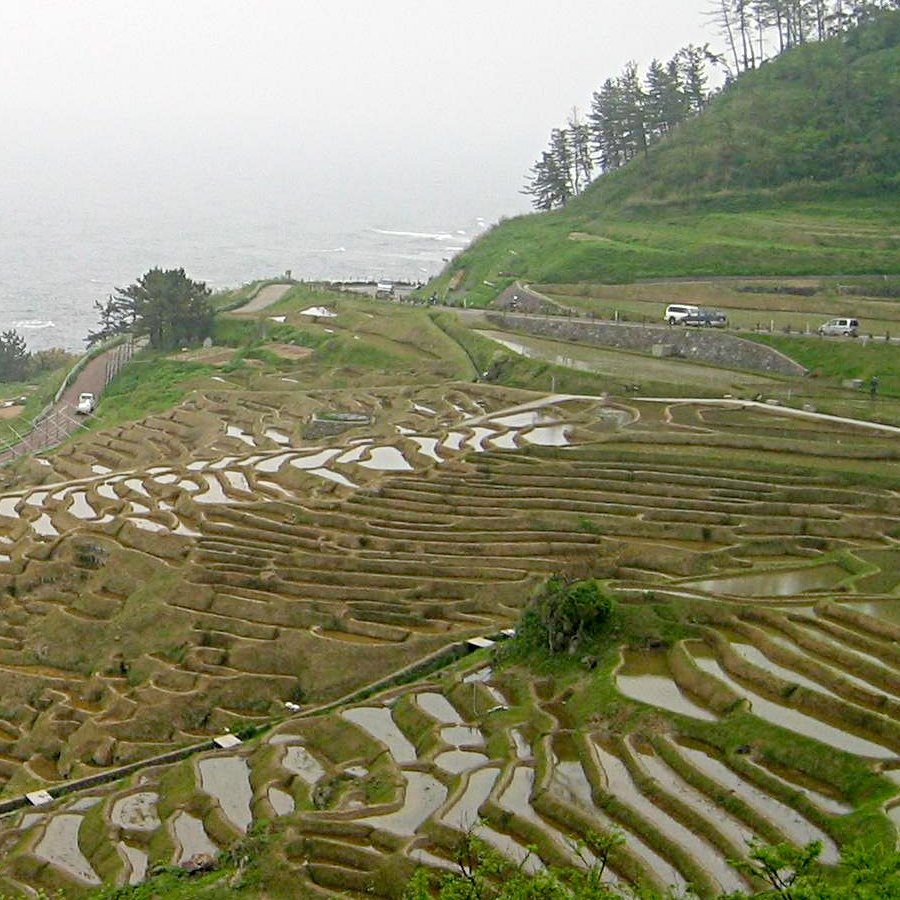
The photo of this blog entry shows rice fields on the Noto peninsula, Ishikawa prefecture, Japan.

Copyright Arto Teräs <ajt@iki.fi>, licensed under the Creative Commons Attribution-Share Alike 3.0 Unported License. (Unless otherwise mentioned in individual photos or other content.)